
Stone Retaining Walls in Atlanta — Built to Hold Your Yard for Decades
In Atlanta, red clay slopes and heavy summer rain make retaining walls a real need — not just a landscaping upgrade. We have been building stone retaining walls across the metro area since 2012. The yards that give homeowners the most trouble are the ones where water and clay team up against gravity.
What We Do
- Install walls for sloped yards, eroding hillsides, and tiered garden beds.
- Offer site evaluations with same-week estimates.
- Build with cut stone, stacked stone, and natural fieldstone.
- Select stone based on your soil, your slope, and what will last on your lot.
As a licensed masonry contractor, we match the right material to the right job. Every wall starts with a site visit so we can see your soil and grade before we recommend anything.
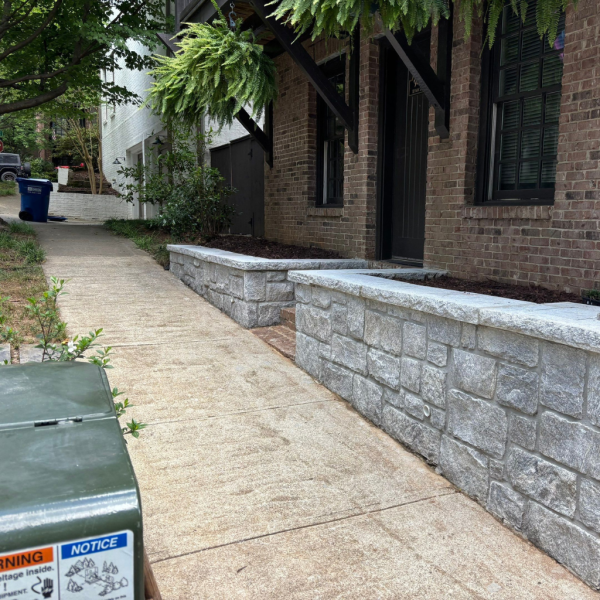
A Proper Base Layer Prevents Every Common Retaining Wall Failure
We get calls every spring from homeowners whose retaining walls are leaning, cracking, or pushing outward. Nine times out of ten, the base is the problem — not the stone, not the height, not the design.
Why Atlanta Clay Is Different:
Clay across Fulton and DeKalb County swells when it absorbs rain and shrinks as it dries.
That cycle repeats hundreds of times a year.
A wall sitting on bare dirt has no chance against that kind of movement.
We start every wall with a compacted gravel base and bury the first course of stone below grade. It is not the exciting part of the job, but it is the part that decides whether your wall is still standing in 20 years.
We have torn out walls that were only 5 years old because the original builder set stone right on top of clay. That homeowner paid twice for the same wall.
The One-Third Rule Decides How Deep Your Wall Footer Must Go
Before we lay a single stone, we figure out footer depth. The rule we follow is straightforward: the footer should equal one-third of the total wall height.
This is not an opinion — it is a structural ratio that keeps the wall from tipping under lateral soil pressure. We have seen walls built with shallow footers that looked fine for a year or two and then started leaning after a wet winter. Once a wall leans, you cannot push it back.
Watch Out for Fill Dirt
- In neighborhoods like Midtown and Druid Hills, soil testing regularly shows fill dirt instead of native ground.
- Fill dirt is loose material brought in during grading or past construction.
- It compresses over time and causes footers to sink unevenly.
- When we find fill, we dig deeper until we hit stable soil — even past the one-third number.
Permits: Atlanta requires a building permit for any retaining wall over 4 feet tall. Some projects need engineered drawings. We handle the permit side and base every footer decision on actual soil conditions.
Stone Retaining Walls Outlast Block and Poured Concrete in Atlanta Clay
Homeowners ask us this question more than almost any other: should I go with stone, block, or poured concrete? Our honest answer is that it depends on the project — but for longevity on Atlanta clay, stone wins.
Natural stone works with Atlanta’s soil rather than against it. The wall moves with the ground instead of fighting it. A well-built stone retaining wall lasts 50 to 100 years.
Stone Types We Use
We pick material based on the look you want and the job the wall needs to do. Sometimes we use both on the same property.
Sloped Yards in Buckhead and East Atlanta Need Walls Before Grading Fails
Some of the most beautiful lots in Atlanta are also the most difficult to manage. Buckhead and East Atlanta Village sit on rolling terrain with sharp elevation changes lot to lot.
Signs Your Slope Needs a Wall
- Mulch washing into the driveway after storms.
- Bare roots where topsoil used to be.
- A foundation that shows a little more every year.
- Yard regraded two or three times with the same result.
Grading alone does not solve a slope problem on clay. You can regrade a yard and it will look great for one season. Then the rain comes, the clay loosens, and the soil migrates right back downhill.
How Terraced Walls Work on Steep Lots
- Shorter walls step up the slope instead of one tall wall taking all the pressure.
- Terraces between tiers create flat, usable space that did not exist before.
- A foundation that shows a little more every year.
- Homeowners turn those tiers into garden beds, seating areas, or simply a yard they can mow without sliding.
Atlanta Summer Storm Fact
Summer storms drop 4 to 5 inches of rain in a single afternoon.
On an unretained slope, that water picks up speed and topsoil on the way down.
A wall breaks that momentum and redirects the water through drainage — not across your property.
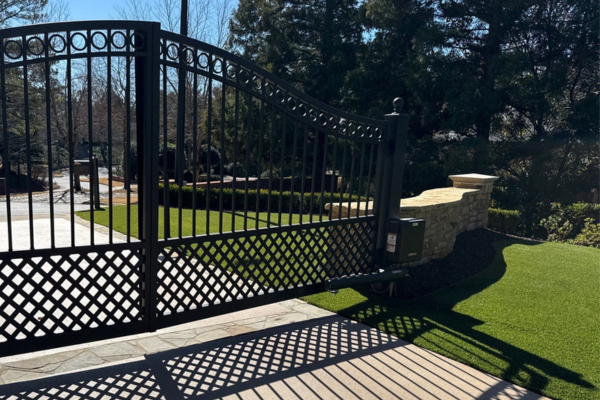
What to Expect During a Stone Retaining Wall Install on Your Atlanta Property
We walk every homeowner through the process before we start. Here is how a stone retaining wall install goes on a typical Atlanta property:
- Site Prep — We mark the wall line, call in utility locates, and clear the work area. Plants or hardscape features you want to keep get protected before digging starts.
- Excavation — We dig the trench to the right footer depth based on wall height and actual soil conditions. If the ground does not match what we expected, we adjust.
- Base Layer — Compacted gravel goes in and gets leveled. The first course of stone sits below grade so the wall is anchored.
- Stone Laying — Each row is set, leveled, and staggered for strength. Perforated drainage pipe and gravel backfill go in during the build — not after.
- Backfill and Grading — Once the wall hits final height, we backfill the remaining space and grade the soil so water flows away from the wall and your home.
Atlanta Weather Planning
Afternoon thunderstorms roll in from May through September.
Our crews start early and cover exposed work before rain hits.
We build the schedule around the weather — we do not rush install steps to beat it.
How to Check Your Finished Retaining Wall for Drainage and Lean
You do not need to be a mason to spot early warning signs. A five-minute check twice a year can save you thousands in repairs. Check once in spring after heavy rains and once in fall.
Common in Grant Park and Kirkwood
Fine clay particles pack into perforated pipe over time.
A clogged drain lets hydrostatic pressure build behind the wall.
That pressure is what pushes walls outward.
Catching these signs early gives you options. A drainage cleanout or partial section rebuild costs a fraction of replacing an entire wall.
How Long Do Stone Retaining Walls Last in Atlanta?
A stone retaining wall in Atlanta typically lasts 50 to 100 years when the drainage and footer depth are done right. That is not a sales number — it is what we see on walls built correctly decades ago that are still standing and straight today.
Atlanta’s red clay holds moisture against the back of the wall longer than sandy or loamy soils. Every stone wall here needs gravel backfill and weep holes to relieve that pressure.
Three Factors That Control Wall Lifespan
Frequently Asked Questions
Questions Homeowners Ask
How do I know my Atlanta yard needs a stone retaining wall?
Soil creep, exposed tree roots, or water pooling against your foundation on any slope are the clearest signs. If your yard loses dirt after every storm or the grade near your home gets steeper each year, a retaining wall will stop that movement and stabilize the slope for good. We see this most on lots with 10 percent grade or more, but even moderate slopes on Atlanta clay cause problems over time.
Do I need a permit for a retaining wall in Atlanta?
Yes — any retaining wall over 4 feet tall in Atlanta requires a building permit. Depending on the wall height and how close it sits to your property line or home foundation, the city may also require engineered drawings. We pull permits on every project that needs one and make sure the design meets code before we break ground.
What type of stone works best for retaining walls in Georgia?
Georgia granite and natural fieldstone perform best in our climate. Granite is dense, heavy, and extremely slow to weather. Fieldstone has a more natural, stacked look and holds up just as well in moisture and temperature swings. We choose between them based on the look you want, the wall height, and how the stone needs to interlock on your specific slope.
How long does a stone retaining wall installation take in Atlanta?
Most residential stone retaining walls take 3 to 7 working days to complete. The timeline depends on wall length, height, slope access, and weather. A short garden-bed wall on a flat lot can finish in 2 to 3 days. A long terraced wall on a steep Buckhead hillside may take the full week or slightly longer.
What causes retaining walls to fail in Atlanta’s climate?
Poor drainage and shallow footers in red clay cause the majority of failures we see. When there is no gravel backfill or drain pipe behind the wall, rainwater soaks into the clay and presses against the stone. That hydrostatic pressure builds over time and pushes the wall outward. A proper drainage system and a footer set to the right depth prevent this completely.
Can a stone retaining wall be built on a steep lot in East Atlanta or Buckhead?
Yes — terraced stone walls are designed for steep grades. Instead of one tall wall carrying all the load, we build shorter walls stepping up the slope. Each tier is sized for the angle of your grade, and the flat areas between tiers give you usable yard space. We have built terraced systems on some of the steepest residential lots in both neighborhoods.