
Modular Block Retaining Walls in Atlanta, Georgia — Built to Hold Your Yard for Decades
We have worked on hundreds of sloped Atlanta lots since 2012. Almost every one starts the same way — a homeowner standing in their backyard, pointing at a red clay bank that washed out after the last storm. Flower beds gone. Mulch in the neighbor’s yard. Sometimes a cracked patio slab tilting toward the house.
A modular block retaining wall fixes that. It holds your soil, levels your yard, and gives you usable space for terracing, garden beds, driveway borders, or just a flat stretch of grass your kids can play on.
We schedule most wall projects from late spring through early fall, when Atlanta ground is driest and our crews can compact gravel without fighting standing water. Our job is to hand you a wall that stays level, drains right, and passes inspection the first time.
What Is a Modular Block Retaining Wall in Atlanta?
A modular block retaining wall uses precast concrete blocks that lock together without mortar. Each row steps back slightly to push against the soil behind it. You see them all over Atlanta on lots with grade changes of two feet or more.
- Made from dense, hollow-core concrete or composite block
- Suited for red clay soils when paired with gravel backfill and drainage pipe
- Heights above four feet usually need geogrid reinforcement per local code
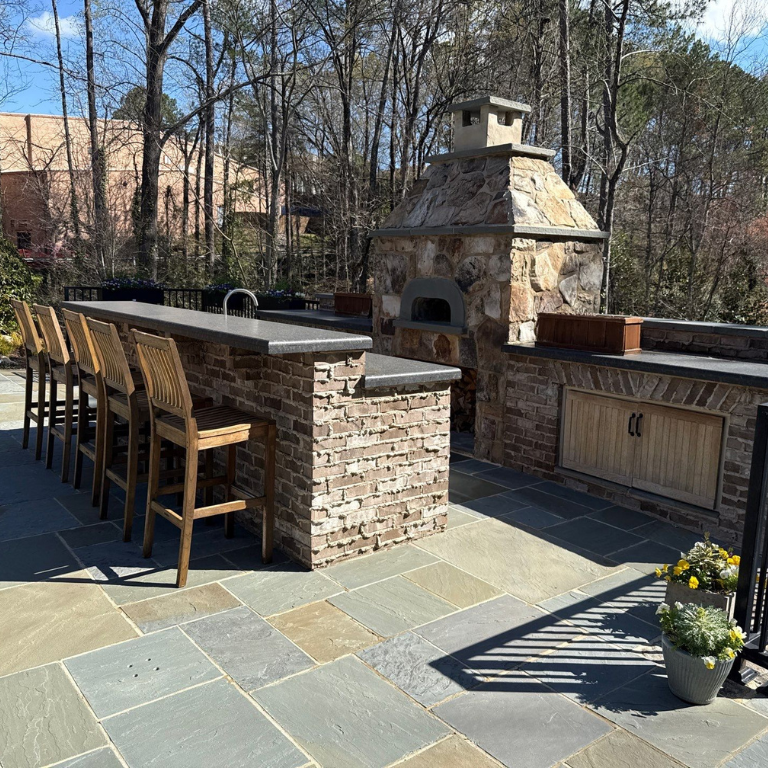
Modular Block Walls Use Interlocking Units That Stack Without Mortar
Here is what makes modular block different from a poured wall or a mortared stone wall. Each block has a lip or pin channel molded into the back edge. You set a block on the row below it, and that lip grabs and holds. No mortar, no cure time, no waiting days between courses.
That dry-stack method is one of the reasons we recommend modular block for most Atlanta retaining wall jobs. Repairs are simpler too. If a single block shifts five years from now, we pull it, fix the drainage behind it, and set it back. Try that with a mortared wall and you are chipping out an entire section.
We also like that modular walls follow curves. Plenty of Atlanta yards are not straight lines — they wrap around patios, follow creek banks, and bend around tree roots. Modular block handles those shapes without custom cutting every piece.
The blocks hold up in cold snaps too. Atlanta does not get harsh winters, but we see hard freezes a few times a year. Poured concrete can crack when water inside it freezes and expands. Modular joints flex just enough to absorb that pressure.
From Our Crew’s Experience
Dry-stacked walls go up faster, come apart easier for repairs, and handle the small ground shifts that red clay causes every wet season. After building walls across Atlanta for over a decade, we reach for modular block more than any other material.
Atlanta’s Red Clay and Slopes Make Proper Footings Critical
If you live in Druid Hills, Buckhead, or any hilly intown Atlanta neighborhood, dig a shovel’s depth in your yard and you will hit red clay. That clay is the reason so many retaining walls in this city fail early.
Red clay swells when it absorbs rain and shrinks when it dries out. Set a block wall directly on that clay, and your footing rides up and down like a slow elevator with every wet-dry cycle. By the second spring, the wall leans.
Our approach is to dig past the soft topsoil, remove the loose clay, and pack six to eight inches of crushed gravel into the trench. Gravel does not swell. It locks into a flat, stable pad once compacted. That gravel base is the single most important step in any Atlanta block wall job — and the step most often skipped by crews trying to save a day of labor.
We have torn out walls that were less than two years old because the original crew poured the first course right on bare clay. The homeowner thought the wall was built right. It looked fine until the first heavy April rain.
Footing Depth by Soil Condition
A Well-Built Block Retaining Wall Lasts 50 Years or More in Georgia’s Climate
We get asked about timber walls a lot. Treated lumber costs less up front, and it looks natural in a wooded yard. But here is what we tell every homeowner who asks: timber rots in Atlanta’s climate faster than you expect.
Georgia summers are humid. Spring rain is heavy and frequent. Treated lumber starts soft at the cut ends and bolt holes within five to seven years. By year ten, most timber walls in Atlanta are leaning, splitting, or attracting carpenter ants. We have pulled out timber walls that were mushy enough to break apart by hand.
Concrete block does not have those problems. It does not rot. It does not rust. Termites and carpenter ants ignore it. A properly drained and footed block wall in Atlanta will still be doing its job when the homeowner’s kids are adults.
The cost math works in block’s favor too. Replacing a timber wall every 10 to 15 years adds up to more than building one block wall that lasts 50 years.
Material Lifespan Comparison in Atlanta’s Climate
Our Honest Take on Timber vs. Block
If you want a wall that you build once and forget about, go with block. If you love the look of timber and accept that you will rebuild it at least once, that is your call. We build both — but we always want you to know the trade-off before you choose.
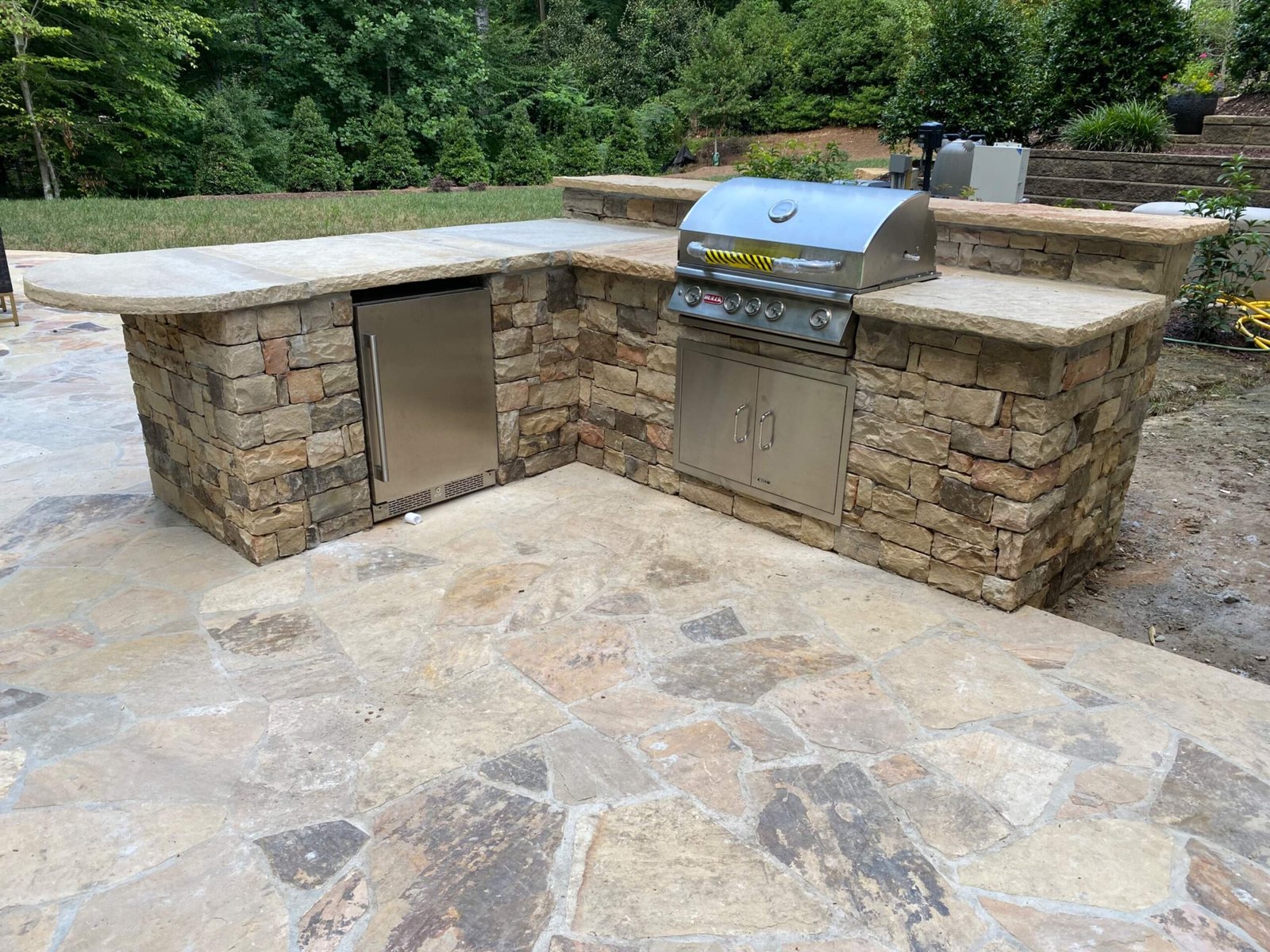
Choosing Between Gravity, Anchored, and Reinforced Modular Walls
This is where a lot of homeowners get confused, and honestly, where a lot of contractors cut corners. Not every wall needs the same engineering. But every wall needs the right engineering for its specific slope and load.
Gravity walls rely on block weight alone. We use these for shorter walls under three feet on gentle slopes — things like raised garden borders or a low terrace step between patio levels. Simple, clean, and quick to build.
Anchored walls use tiebacks or deadman anchors buried into the hillside behind the wall. We build a lot of these in East Atlanta and Grant Park, where older homes sit on lots with steep drops in the backyard. The anchor keeps the wall from tipping under that extra soil pressure.
Reinforced walls add layers of geogrid between courses. The geogrid sheets extend back into the soil and act like roots holding the wall to the earth behind it. This is what you need when a wall goes above four feet or carries extra weight from a driveway or patio above it.
Matching the wall type to your actual load prevents two expensive mistakes. Overbuilding a short garden wall wastes your budget. Underbuilding a tall hillside wall risks a collapse within a few seasons.
Quick Guide: Which Wall Type Fits Your Lot?
Under 3 feet with a mild slope → Gravity wall
3–4 feet or steep rear grade → Anchored wall
Over 4 feet or heavy load on top (driveway, patio) → Reinforced wall with geogrid
Drainage and Compaction Steps That Prevent Wall Failure in Atlanta
Atlanta averages about 50 inches of rain per year. We feel every one of those inches on the job site. Water is the number one enemy of a retaining wall, and in our experience, poor drainage is the number one reason walls fail in this city.
Here is what happens without drainage. Rain soaks through the soil behind the wall. That wet soil gets heavy — a lot heavier than dry soil. The weight pushes against the back of the wall. With nowhere to drain, the pressure builds until the wall tilts forward. We have seen walls go from plumb to two inches out of line in a single wet spring.
Our drainage process starts at the base. We lay a perforated drain pipe along the bottom of the wall, wrap it in filter fabric, and pack clean gravel around it. Water seeps down through the backfill gravel, enters the pipe, and runs out to a daylight outlet downhill from the wall.
Behind the block, we backfill with angular crushed gravel — not round river rock, which rolls and does not lock together. Every six-inch lift gets run over with a plate tamper until it will not move under a boot heel. That compaction step is tedious, but it is what separates a wall that holds from a wall that leans.
Drainage Checklist for Atlanta Block Walls
- Perforated pipe at the wall base, sloped to a daylight outlet
- Filter fabric wrapped around the pipe to keep clay fines out
- Clean angular gravel backfill — not rounded river rock
- Plate tamper compaction on every six-inch gravel lift
- Outlet directed downhill, away from the wall and your foundation
Why We Are Picky About Gravel Shape
Angular crushed stone locks together when compacted. Round river rock shifts and rolls under load. We have seen walls fail because a crew used the wrong gravel to save a few dollars per ton. The stone shape matters.
Seasonal Inspection Keeps Your Retaining Wall Safe After Heavy Atlanta Rain
Once your wall is finished, it mostly takes care of itself. But a five-minute walk after a heavy storm can save you thousands of dollars down the road. Atlanta’s spring and summer thunderstorms drop a lot of water in a short window, and that is when walls get tested the hardest.
Here is what to look for. Walk the length of the wall and sight down the top edge. If a block has shifted out of line, you will see it. Check the cap row for new cracks. Look at the base — water should drain away, not pool against the wall face. Then check your drain outlet. If water is not flowing out after a rain, something is blocked.
A single shifted block usually means a small drainage issue right behind that spot. Fix it early and it stays a minor repair. Ignore it and you may need to pull out three or four courses to rebuild the section.
Seasonal Wall Inspection Guide
A Tip from the Field
Keep a phone photo of your wall from the day it was finished. When you do your seasonal check, compare the current wall to that photo. Small shifts are hard to spot by memory, but easy to see side by side.
Frequently Asked Questions
Questions Homeowners Ask
Do modular block retaining walls in Atlanta need a permit?
Yes — walls over four feet tall typically require a permit in Fulton and DeKalb counties. Your contractor should pull that permit before any digging starts. We handle the paperwork and schedule inspections so you do not have to chase the county office yourself.
How deep should footings be for a block wall on Atlanta clay soil?
Most Atlanta builds need six to eight inches of compacted gravel below the first course. That depth gets past the soft clay layer and gives the wall a base that will not shift when the soil swells after rain. On steeper or wetter lots, we go deeper.
When is the best season to build a retaining wall in Atlanta?
Late spring through early fall works best. The ground is driest, the days are longest, and our crews can compact gravel without fighting puddles. We avoid peak wet weeks in March when clay stays soggy and slows every step.
Can a modular block wall be built on a steep Atlanta hillside?
Yes, and steep lots are some of our most common jobs. Neighborhoods like Kirkwood and Candler Park have yards that drop several feet from front to back. We use geogrid reinforcement and build in terraced steps so the wall follows the grade instead of fighting it.
How do Atlanta contractors handle drainage behind a retaining wall?
We lay perforated pipe at the base, surround it with clean gravel, wrap it in filter fabric, and run the outlet downhill away from the wall. That system gives water a clear path out instead of letting it build pressure behind the block.
What happens if my block retaining wall starts leaning after heavy rain?
Leaning almost always points to a drainage problem or a footing that was not deep enough. A masonry contractor can open up the affected section and figure out whether you need a partial rebuild or a full replacement. The sooner you call, the smaller the repair tends to be.