
Brick Retaining Walls in Atlanta — Built to Hold Your Yard for Decades
If your yard slopes toward your house or drops off behind it, you already know the problem. Atlanta’s red clay soil shifts with every rainstorm and dry spell. A brick retaining wall holds that soil in place — for good.
This page walks you through what a proper brick retaining wall takes. We cover footings, drainage, gravel backfill, material comparisons, and warning signs of wall failure. Every step matters when the goal is a wall that lasts decades, not just a few seasons.
We handle the full build — from digging footings in red clay to laying the final course of brick. You get a wall that does its job without constant repairs.
Atlanta’s Red Clay Slopes Need Proper Footings Before Any Brick Goes Up
A brick retaining wall is only as strong as what sits underneath it. In Atlanta, that means a poured concrete footing sized to match your wall height.
Red clay is the reason this step can’t be skipped. It expands when wet and shrinks when dry. That constant movement will shift a wall that isn’t anchored to something solid below it.
What proper footings require here in Atlanta:
- The footing sits below the frost line and reaches stable, compacted subgrade beneath the clay layer
- Width and depth are matched to wall height — a taller wall needs a wider, deeper footing
- The subgrade is compacted before the pour so the footing doesn’t settle unevenly over time
If you own a sloped lot in Grant Park, East Atlanta, or Reynoldstown, your yard likely sits on several feet of red clay. That’s exactly the kind of ground where a correctly sized footing prevents settling and tilt for the life of the wall.
A footing isn’t just the first step. It’s the one that decides whether your wall stands straight 20 years from now.
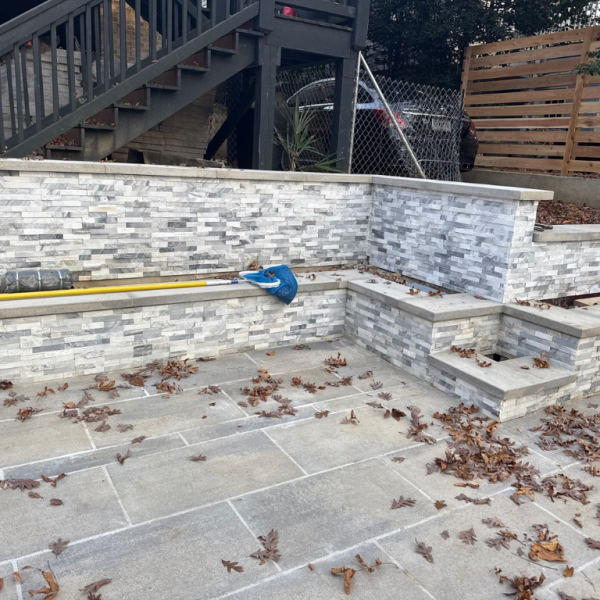
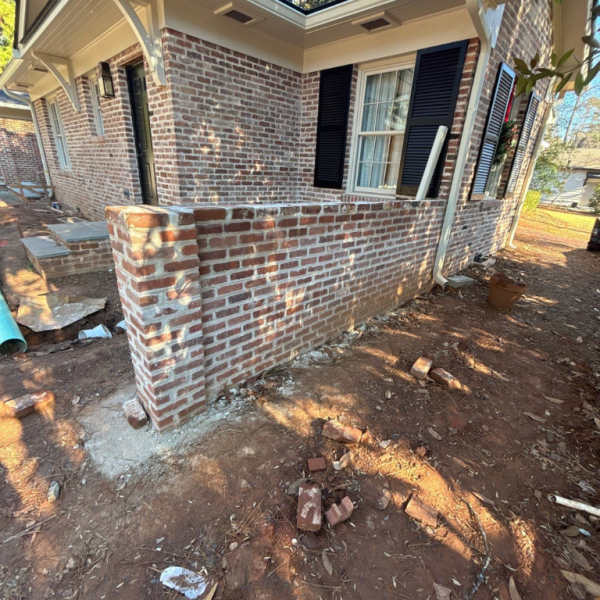
Drainage Behind the Wall Prevents the Biggest Failures
Most brick retaining walls that fail don’t fail because of the brick. They fail because water built up behind them with nowhere to go.
Atlanta averages over 50 inches of rain per year. When that water hits clay soil, it doesn’t drain through — it sits. That trapped water creates hydrostatic pressure against the back of the wall. Over time, that pressure pushes the wall forward until it leans, cracks, or collapses.
Three drainage components we install during every build:
- Perforated drain pipe at the base of the wall, wrapped in filter fabric to keep clay from clogging it
- 12-inch gravel backfill layer between the soil and the brick, giving water a clear path downward
- Weep holes spaced every 6 to 8 feet along the wall face so water exits instead of pooling
Buckhead and Midtown hillside properties face especially heavy runoff during spring storms. On those lots, drainage isn’t optional — it’s what keeps the wall standing through April and May.
We install drainage layers during construction. Adding them after the wall is built means excavation and, in many cases, a full rebuild.
Do Brick Retaining Walls Need Drainage in Atlanta?
Yes — every brick retaining wall in Atlanta needs drainage behind it. Atlanta’s red clay holds water instead of letting it pass through. Without drainage, hydrostatic pressure builds and pushes the wall forward.
Key drainage components:
- Perforated drain pipe at the base, wrapped in filter fabric
- 12-inch gravel backfill layer between soil and brick
- Weep holes spaced every 6 to 8 feet along the wall face
Atlanta’s seasonal heavy rains in spring and summer make drainage even more critical. A masonry contractor installs these layers during construction — not after.
Gravel and Backfill Are What Keep a Brick Retaining Wall Standing
What you see is brick. What holds it all together is what’s behind the brick — gravel and compacted backfill.
Clean gravel sits directly behind the wall. Its job is simple: let water pass through freely so it reaches the drain pipe at the base. Without that gravel layer, water hits the clay, stops, and starts pressing against your wall.
Compacted backfill goes behind the gravel zone. It supports the wall structurally and keeps the retained soil from shifting into the drainage layer.
What happens when these layers are skipped:
In Atlanta’s clay-heavy soil, this applies to every property — not just steep ones. Homes in Decatur and Druid Hills on gentle slopes still need full backfill and gravel specs. Clay doesn’t care about your grade percentage. It holds water the same way everywhere.
Brick Outlasts Cheaper Materials When the Wall Has to Bear Real Load
You can build a retaining wall out of timber, concrete block, or poured concrete. Each one costs less than brick upfront. But upfront cost and long-term cost are two different numbers.
Brick paired with a reinforced core handles lateral soil pressure for 50 years or more with minimal upkeep. Here’s how it compares in Atlanta’s climate:
Atlanta’s winters bring enough freeze-thaw cycles to break down timber walls fast. Summer humidity speeds up rot. Brick doesn’t absorb moisture the same way. It doesn’t attract insects. And it doesn’t fade or soften under UV exposure the way wood does.
If your wall has to hold back real soil weight on a sloped lot, brick gives you the longest service life with the least ongoing maintenance.
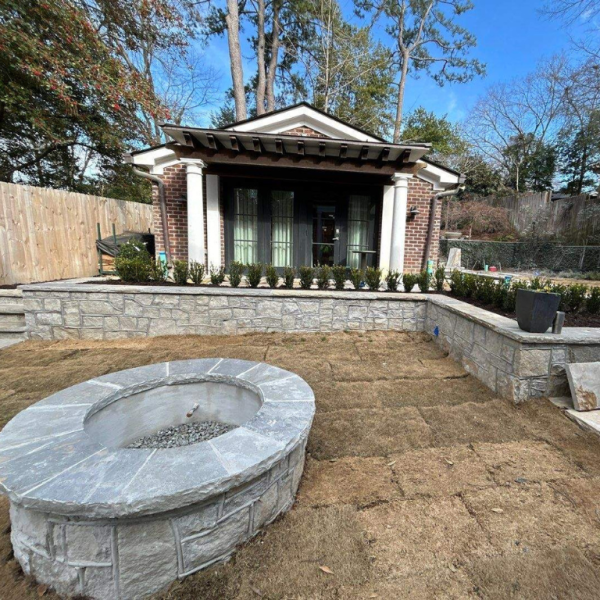
Leaning, Cracking, and Bulging — How to Spot Retaining Wall Problems Early
A retaining wall doesn’t fail overnight. It shows signs first. Catching those signs early means a targeted repair instead of tearing the whole wall out.
Warning signs to watch for:
- Leaning or tilting — The wall leans away from the soil it’s holding. Even a small lean gets worse over time.
- Horizontal cracking — Cracks running along mortar joints signal pressure from behind the wall.
- Bulging — A section of the wall bows outward. This usually means water is trapped behind that spot.
- Separation at the base — A gap forming between the wall and the ground means the footing may be shifting.
- Soil spilling over the top — The retained soil is moving faster than the wall can hold it.
If you live in Sandy Springs or Virginia-Highland and notice any of these signs, seasonal soil movement is likely the cause. Atlanta’s clay expands in wet months and shrinks during dry spells. That back-and-forth motion accelerates wall displacement — especially if the original build lacked drainage or proper footings.
Don’t wait for a full lean to call someone. A crack today is a rebuild next year if it goes unchecked.
Frequently Asked Questions
Questions Homeowners Ask
How deep do footings need to be for a brick retaining wall in Atlanta?
Footings typically go 18 to 24 inches below grade. That puts them below Atlanta’s shallow frost line and into stable soil beneath the red clay layer. Depth may increase for taller walls or steeper slopes.
Can I add drainage to an existing brick retaining wall?
Retrofitting drainage is possible but it requires excavating behind the wall. In some cases, a masonry contractor may find that a full rebuild is more practical than trying to work around the existing structure.
How tall can a brick retaining wall be before it needs a permit in Atlanta?
Walls over 4 feet in Fulton County and the City of Atlanta generally require a permit and an engineered design. Requirements vary by jurisdiction, so check with your local permitting office before starting.
What causes a brick retaining wall to lean?
Water buildup behind the wall is the most common cause in Atlanta. Poor drainage lets hydrostatic pressure push the wall outward over time. Undersized footings and lack of backfill compaction also contribute.
Do brick retaining walls work on steep hills in Atlanta neighborhoods?
Yes. Steep lots in areas like Inman Park or East Atlanta often use tiered brick walls. Tiering breaks the grade change into shorter, structurally sound steps instead of relying on one tall wall.
How long does it take to build a brick retaining wall?
Most residential walls take 1 to 2 weeks depending on wall length, height, and site prep. Atlanta’s spring rain can add a few days for drying time between concrete pours and brickwork.