
Retaining Walls Contractor in Atlanta
In Atlanta, sloped yards and red clay soil make retaining walls one of the most common calls we get. We’ve seen it hundreds of times — a homeowner watches their backyard wash downhill after a heavy spring rain, or a builder realizes the lot grade won’t work without a structural wall first. If that sounds familiar, you’re in the right place.
We build two main types of retaining walls: CMU block and modular block. They solve different problems, and picking the wrong one wastes your money. A four-foot garden border does not need rebar and grout. A ten-foot grade change behind your garage does not belong on dry-stacked blocks. This page breaks down both options honestly so you can walk into your estimate already knowing what fits your yard.
Here’s how we work. You call or fill out our form, and we set up a site visit. We come out, look at the slope, test the soil, and check where your water goes when it rains. Then we tell you what we’d recommend — and just as importantly, what you don’t need. Our crew has been building retaining walls across Atlanta since 2012, and we’d rather talk you out of overbuilding than sell you something your lot doesn’t call for.
CMU Block vs. Modular Block at a Glance
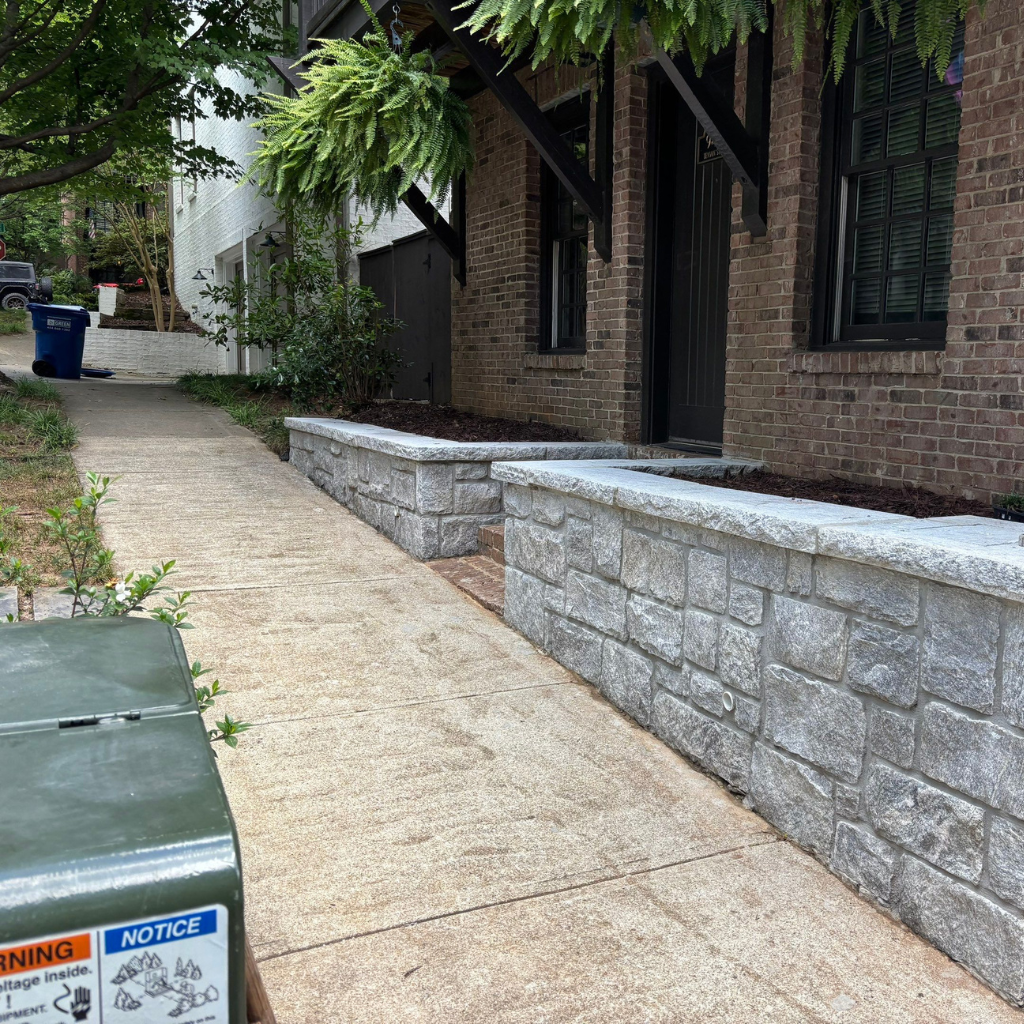
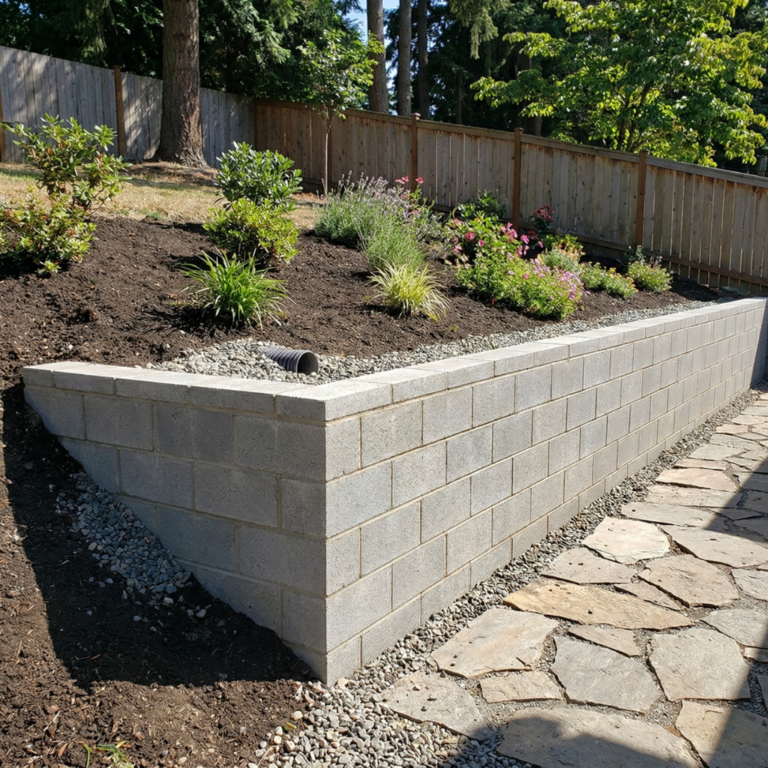
CMU Block Retaining Walls in Atlanta
If your property has a serious grade problem, a CMU (concrete masonry unit) wall is usually the right answer. We’re talking about steep drop-offs, hillside lots, or anywhere the wall needs to hold back thousands of pounds of wet soil. Homeowners in Buckhead and Druid Hills call us for cinder block retaining walls more than almost any other service, because those neighborhoods sit on some of the sharpest grade changes in the city.
Here’s what makes CMU different from everything else: every block gets reinforced with steel rebar and filled solid with grout. That turns a stack of hollow blocks into one connected structure. It doesn’t shift. It doesn’t bow. After ten or fifteen years of Atlanta’s spring downpours, a properly built CMU wall still looks the same as the day we finished it.
A word of honest advice: CMU walls cost more than modular block. They take longer to build, and the site prep is heavier. If your wall only needs to be two or three feet tall, this is probably more than you need. We’ll tell you that during the site visit. But if your wall is going above four feet, or if it’s holding back a hillside next to your driveway or foundation, CMU is what we’d put behind our own house.
Why Drainage Makes or Breaks a CMU Wall in Atlanta
We’ve repaired retaining walls all over Atlanta that failed not because of bad block or weak mortar, but because nobody dealt with the water. Atlanta’s red clay holds moisture like a sponge. After a few heavy rains, that saturated clay swells and pushes against the back of the wall with real force. Every CMU wall we build includes a gravel drainage layer behind the block and weep holes near the base. That water has to go somewhere — if you don’t give it a path out, it will find one on its own, and you won’t like where it ends up.
What to Expect with a CMU Block Wall
- We visit your property first and check the slope, soil type, and where water collects after rain. No guessing from photos.
- We dig a footing trench below grade and pour a reinforced concrete footer. This is the part most people never see, but it’s where the wall gets its strength.
- Every course of block is set with rebar and grout — not just the bottom row or every other row.
- Drainage gravel and weep holes go in behind every wall. We don’t treat drainage as an add-on.
- This is the wall type we recommend for commercial sites, multi-family properties, and any residential lot where the grade change is more than four feet.
Modular Block Retaining Walls in Atlanta
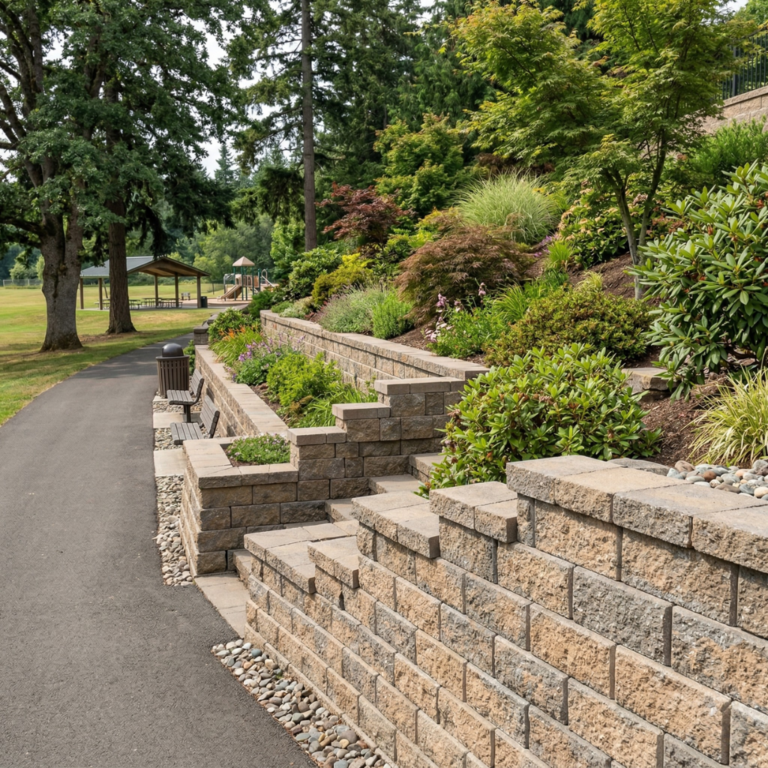
Not every retaining wall needs to be a structural project. If you have a sloped backyard, want raised flower beds, or need a terraced border around your patio, modular block is the practical choice. These interlocking concrete blocks stack and lock together without mortar, which keeps the build clean and the timeline short. We install a lot of segmental retaining walls across Midtown and East Atlanta, where older landscaping often needs reshaping as yards settle over the years.
Here’s what we like about modular block for the right project: you get a finished, professional look the same day the last block goes down. There’s no curing time, no form removal, and no coating to apply later. For walls under four feet, the blocks do the job without overcomplicating things.
One thing to keep in mind: modular block has limits. If your wall needs to go above four feet, or if it’s holding back a steep slope next to a structure, we’ll usually steer you toward CMU instead. We’d rather recommend the right wall type than come back in three years to fix a wall that wasn’t built for the load.
How Modular Walls Handle Atlanta’s Winter Ground Movement
Atlanta doesn’t get brutal winters, but we do get enough freeze-thaw cycles in late January and February to shift the soil. A rigid wall cracks under that movement. Segmental retaining walls have a small amount of flex built into the joints, so when Georgia’s clay-heavy ground expands and contracts with moisture changes, the blocks move with it instead of fighting it. That flex is one of the reasons we recommend modular block for shorter landscape walls — it handles the seasonal ground shifts without showing damage.
What to Expect with a Modular Block Wall
- Interlocking concrete blocks stack and lock in place with no mortar and no messy jobsite.
- Most residential modular walls go up in a fraction of the time a CMU wall takes.
- These walls work best at heights under four feet. Above that, we talk to you about other options.
- The finished face looks clean and uniform right away — no extra facing, stucco, or stone veneer needed.
- A solid choice for sloped backyards, raised garden beds, terraced patio edges, and driveway borders.
Frequently Asked Questions
Questions Homeowners Ask
What is the difference between a CMU block and a modular block retaining wall?
A CMU wall uses concrete masonry units reinforced with rebar and grout, while a modular wall uses interlocking blocks that stack without mortar. In our experience, the decision usually comes down to height and load. If your wall is under four feet and the slope behind it is mild, modular block does the job well. Anything taller or load-bearing, we go with CMU.
How tall can a retaining wall be without an engineer?
In the Atlanta area, walls over four feet generally need an engineered design. We see homeowners try to skip this step to save money, and it rarely ends well. We check your slope and soil during the site visit and let you know up front whether engineering is needed. If it is, we handle the coordination so you’re not chasing down a structural engineer on your own.
Why does drainage matter behind a retaining wall?
Drainage prevents water from building up behind the wall and pushing it forward. We bring this up because it’s the number one reason retaining walls fail in Atlanta. Our red clay soil holds water and swells after rain. Every wall we build — CMU or modular — includes gravel backfill and a way for water to exit, whether that’s weep holes, a perforated drain pipe, or both.
Do I need a permit for a retaining wall in Atlanta?
Permit rules depend on wall height and which jurisdiction your property falls under. The City of Atlanta, DeKalb County, and Fulton County each have their own rules for retaining walls above a certain height. We check the local requirements for your specific address during the estimate so you don’t have to sort it out yourself.
How long does it take to build a retaining wall?
Most residential retaining walls take between a few days and two weeks, depending on wall type, height, and how much site prep the lot needs. Modular block jobs tend to move faster. CMU jobs that need footings and rebar take longer but last longer under heavy loads. We give you a clear timeline after the site visit — no vague ranges.
How do I know if my existing retaining wall needs to be replaced?
Leaning, cracking, or bulging in the middle are the most common warning signs. If you see water seeping through the face of the wall or the top course shifting out of line, the wall is under more pressure than it can handle. We get calls like this often in older Atlanta neighborhoods. Sometimes a repair is enough. Other times the original wall was undersized or had no drainage, and starting over is the better investment. We’ll give you a straight answer on which one applies to yours.