
Professional Outdoor Fountain Installation in Atlanta, GA
We have been building stone and masonry features across Atlanta since 2012. Fountains are one of our favorite projects because they change how a space feels the moment you turn the water on. The sound alone does something a fire pit or a retaining wall just cannot do.
We install custom fountains for courtyards, garden beds, pool surrounds, and front entries. Most of our fountain work lands in neighborhoods like Buckhead, Druid Hills, Virginia-Highland, and Decatur, but we work across the metro.
Here is what every fountain project with us includes:
- An on-site consultation where we look at your space, water access, and soil conditions in person
- Base prep with compacted gravel and a poured masonry foundation — not just setting a fountain on top of dirt
- Plumbing routing for a supply line, recirculating pump, or both depending on the design
- Final testing and a hands-on walk-through so you know exactly how to run and care for it
This page walks you through what the process looks like, how to prepare your property, and how to book with us. Legacy Stonescapes is a licensed masonry contractor serving Atlanta neighborhoods with the experience to clean and protect your surfaces for the long term.
Our honest take: A fountain is only as good as what it sits on. We have torn out other installers’ work where the fountain was gorgeous but the base was a 2-inch concrete slab poured over raw clay. It cracked within a year. We build fountain foundations the same way we build retaining wall footings. That is the difference between a 3-year fountain and a 30-year fountain.
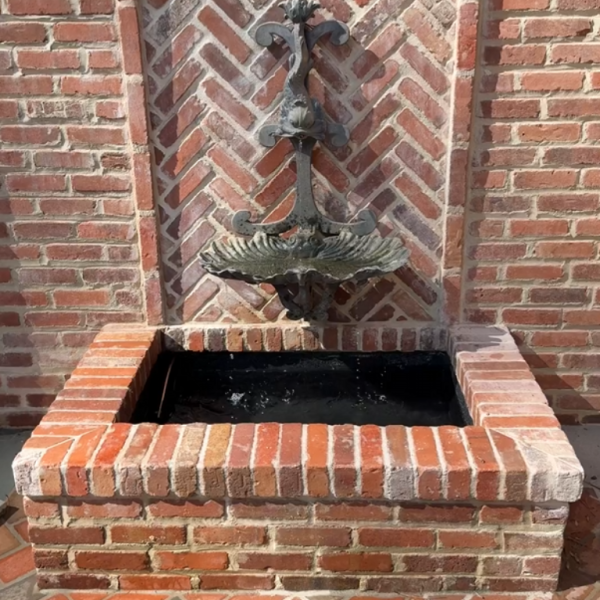
Most Atlanta Fountains Need a Dedicated Water Line and Drain
This is the question that catches most homeowners off guard. You pick a beautiful fountain, get excited about placement, and then find out the install needs a plumber, a trench across the yard, and a permit. We would rather you hear that from us early than get surprised halfway through the project.
If you are adding a fountain to an established landscape in Buckhead or Druid Hills, your first decision is how water gets to the basin and where it goes after. That answer depends on the fountain size and how much you want to maintain it.
Plumbing Options at a Glance
| Setup | Best For | What It Requires |
|---|---|---|
| Recirculating pump | Garden and patio fountains — the setup we install most often | GFCI outlet; no water-line tap |
| Plumbed supply line + drain | Large or multi-tier fountains that lose water fast | Licensed plumber; dedicated drain |
| Hybrid (pump + auto-fill valve) | Homeowners who travel or do not want to monitor water levels | GFCI outlet; small supply connection |
We lean toward recirculating setups for most residential installs. They are simpler, cheaper, and give you fewer things to break. A plumbed line only makes sense when evaporation or flow volume demands it.
What we see go wrong: Atlanta gets 50+ inches of rain a year. We have walked jobs where someone set a fountain basin at the low point of a patio with no drain. Every storm turned it into a pond. We always slope the surrounding grade away from the base and add a French drain if the grade works against us. Drainage is not an afterthought here — it is part of the foundation plan.
Stone and Cast Stone Hold Up Best in Atlanta's Heat and Humidity
We get asked about material choice on every single fountain project. And we have a strong opinion on this one: go with natural stone or sealed cast stone. Everything else is a compromise.
We are not against concrete or resin in every situation. But your fountain is going to sit through 90-degree summers, weeks of 80%+ humidity, and a pollen season that coats every surface in yellow dust. Cheap materials show that wear fast. Good stone just looks better over time.
Material Comparison — What We Actually See in the Field
Pollen season reality: If you live in Midtown or Inman Park, you already know what March through May does to every outdoor surface. Porous, unsealed materials trap that yellow film in their pores and turn green by summer. Sealed cast stone wipes clean with a garden hose in five minutes. That one material choice saves you hours of scrubbing every year. We have cleaned enough fountains to know the difference is night and day.
A Solid Masonry Base Prevents Settling in Georgia Red Clay
If you have ever watched a fence post lean over after a couple of rainy months in Atlanta, you already understand our red clay. It is dense, sticky, and it moves. Wet clay expands. Dry clay shrinks. A 500-pound fountain sitting on top of that is going to shift. Not might — will.
We have pulled out enough tilted, cracked fountains installed by landscapers and handymen to know what skipping the foundation step costs. Every fountain we install gets the same base treatment we give our retaining walls. There are no shortcuts on this part.
Here is what every fountain project with us includes:
- Excavation — we dig past the clay layer to stable subsoil, usually 12-18 inches depending on the site
- Gravel base — a compacted drainage layer that keeps water from pooling under the fountain and softening the soil
- Masonry pad — a poured or mortared pad sized to the fountain's footprint and weight, not a generic slab
- Level check — we confirm the pad is dead flat before the basin goes on; fixing a tilt later means starting over
Sloped lots — we see this constantly: Grant Park and East Atlanta are full of beautiful sloped yards. Gravity pulls saturated clay downhill, and anything sitting on that slope moves with it. We have gotten calls from homeowners whose fountains were installed on a slope without a proper footing. By year two, the basin was tilted and leaking. A masonry footing anchors the fountain in place, even on a grade. If your installer does not talk about soil conditions during the estimate, that should concern you.
Your Installer Should Set the Basin, Pump, and Plumbing in One Visit
We are not fans of multi-visit fountain installs. Some companies dig the hole on Monday, come back Thursday to set the base, and then schedule the plumbing for the following week. Meanwhile, your yard is torn apart and every afternoon thunderstorm fills the trench with water.
We show up with the base materials, basin, pump, plumbing fittings, and sealant. Everything needed to finish in one trip. For most residential fountains, that means one to two days from first shovel to running water.
What Happens on Install Day
A lesson from Atlanta spring weather: If you have scheduled any outdoor work in Sandy Springs or Alpharetta between March and May, you know what afternoon storms do to an open job site. An uncovered excavation fills with water in one downpour. Wet trenches collapse. Loose gravel washes into the neighbor’s yard. One-visit scheduling is not just about convenience — it protects the quality of the work.
Do Outdoor Fountains Need Plumbing in Atlanta?
Most permanent outdoor fountains in Atlanta need a water supply line and a drain or recirculating pump. Self-contained fountains recirculate water through an internal basin but still need a nearby GFCI outlet for the pump. A masonry contractor handles basin setting, pipe routing, and pump hookup during installation.
- Recirculating pumps are common for garden and patio fountains
- Plumbed supply lines suit large or multi-tier fountains
- Atlanta code may require a licensed plumber for new water-line taps
A Properly Sealed Fountain Won't Attract Pests or Algae
Standing water breeds mosquitoes. That is not a scare tactic — it is biology. In Atlanta’s warm, humid summers, a neglected fountain basin can become a breeding ground within a week. We take that seriously because a fountain is supposed to make your backyard better, not give you a mosquito problem.
The fix is straightforward, but it has to be done right during installation. You cannot seal your way out of a bad pump choice or add circulation after the fact without tearing things apart.
How We Prevent Stagnant Water
- Pump sizing — we match the pump's flow rate to the basin volume so there are no dead corners where water sits flat; an undersized pump is the most common mistake we see on other people's installs
- Continuous recirculation — moving water does not give mosquitoes the still surface they need to lay eggs; the pump should run any time the fountain is active
- Interior basin sealing — waterproof sealant blocks moisture from soaking into the stone pores where algae take root
- Joint sealing — every seam between basin pieces gets sealed to prevent slow leaks that attract pests underneath the fountain
What humidity does to an unsealed fountain: If you live in Virginia-Highland or Decatur, you have seen what humidity does to outdoor stone. Surfaces never fully dry between May and September. On an unsealed fountain, algae gets established in weeks — not months. A proper sealant on the basin walls makes cleaning a five-minute job with a soft brush instead of a weekend project with a pressure washer. We have seen both outcomes. The sealed version wins every time.
Seasonal Maintenance Keeps Atlanta Fountains Running for Years
A well-built fountain is low maintenance. It is not zero maintenance. We are honest about that because some installers make it sound like you will never think about it again. You will — just not very often.
Here is what we tell every client after install day. Follow this schedule and your fountain will run well for 10-15 years before the pump needs replacing.
Seasonal Care Schedule
Our winter advice: Full winterization is overkill for most Atlanta fountains. We do not drain and wrap every fountain like you would in Ohio. But when the forecast shows a hard freeze, either drain the lines or keep the pump running overnight. Moving water resists freezing far better than still water. A cracked pump is a $300-$600 repair that is 100% avoidable with five minutes of prep. We send our clients a reminder text before the first freeze each year.
Frequently Asked Questions
Questions Homeowners Ask
Do I need a permit to install an outdoor fountain in Atlanta?
Most decorative fountains do not require a building permit in the City of Atlanta. The exception is when your project involves a new water-line tap — Fulton County may require a plumbing permit for that connection. We check permit requirements during every consultation so you are not dealing with surprises mid-project.
How long does a fountain installation take in Atlanta?
Most residential installs take one to two days. A simple recirculating patio fountain on flat ground wraps up in a single day. Multi-tier designs on sloped lots with plumbed supply lines can push to two days, especially if we are building a larger masonry base.
Will an outdoor fountain raise my Atlanta water bill?
No — at least not in any way you would notice. Recirculating pumps reuse the same water. The pump’s electric cost runs about the same as leaving a small lamp on. You will top off the basin every week or two in the summer to cover evaporation, but we are talking about a garden hose for 30 seconds.
What fountain style works best for small Atlanta patios?
Wall-mounted or single-tier basin fountains are your best bet when square footage is tight. We have installed these in Reynoldstown and Old Fourth Ward courtyards where there was barely room for a bistro table. You still get the sound of running water without giving up your only usable outdoor space.
Can a fountain be added to an existing Atlanta patio or retaining wall?
Yes, and we do this regularly. We cut into existing stone or block, route plumbing through or behind the wall, and seal everything so the retrofit blends with what was already there. The key is matching the stone and mortar color — that is where having a masonry contractor do the work instead of a general handyman makes a visible difference.
When is the best time of year to install a fountain in Atlanta?
Late spring through early fall gives us the best conditions for curing sealant and setting mortar. We try to avoid peak summer rain weeks in July and August when afternoon storms hit almost daily. Fall is actually our favorite season for fountain installs — the weather is dry, temperatures are mild, and the ground stays workable through November.
Schedule Your Atlanta Fountain Consultation
We would like to walk your property, look at the soil, check your water access, and talk through what makes sense for your space and budget. No pressure, no generic quotes off a price list. Every fountain site is different and we treat it that way.
Call us: (404) 989-2700 | Online: Request form or Google Business Profile message